AI agent audit trail

An AI agent audit trail for work nobody watched happen

Agents now run steps of your research on their own, overnight and in parallel.

The trail itself

What the record of an unattended run looks like
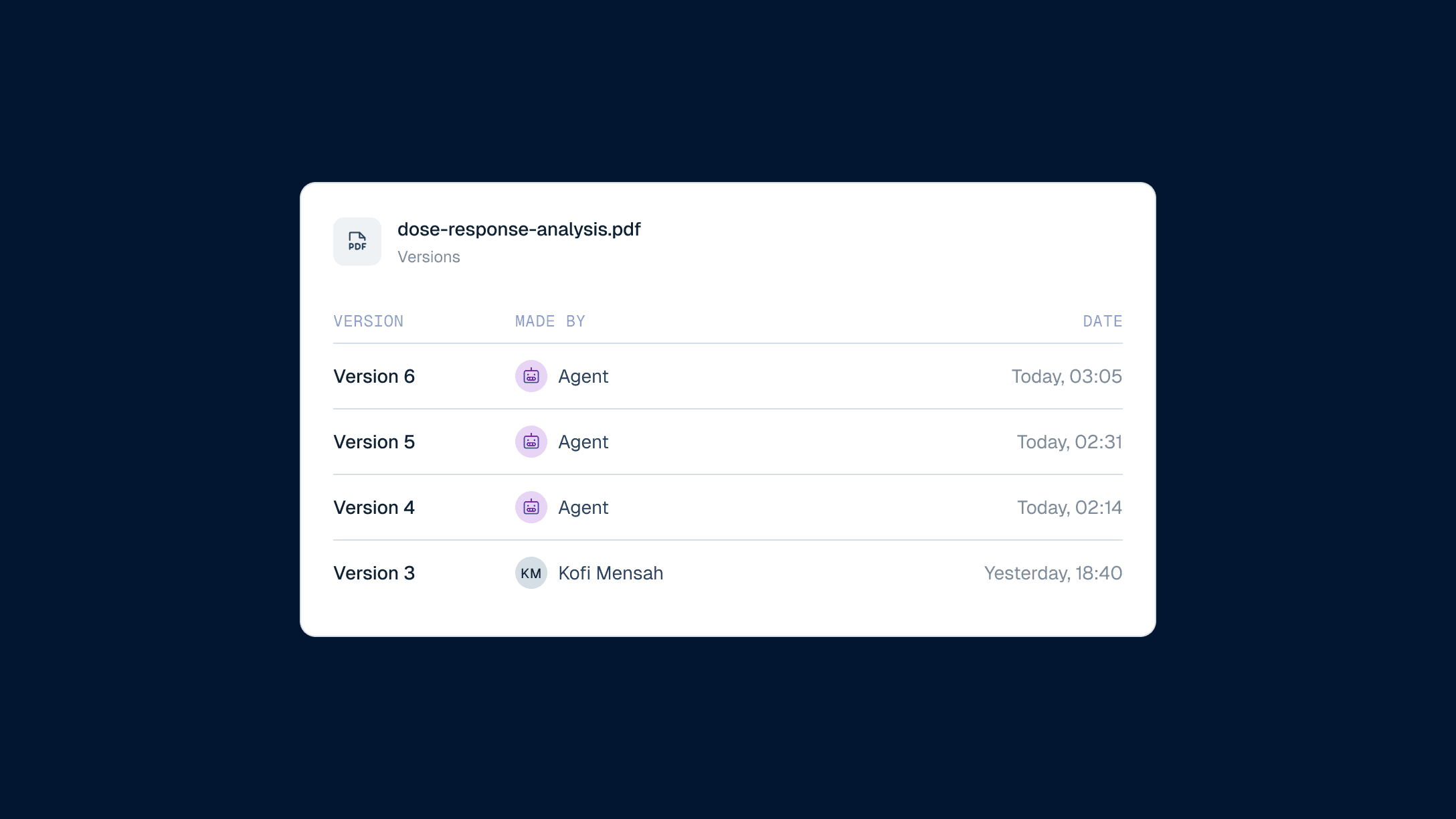
When an agent signs in with its own account, every file it adds or changes lands in the same timeline a person’s work does, under the agent’s identity rather than whoever configured it.
A file's versions after an overnight run: versions 4 to 6 made by an agent between 02:14 and 03:05, version 3 by Kofi Mensah yesterday.

How an agent gets an identity of its own

Four steps, and none of them require a person to be at a keyboard when the agent runs.

01

Add the agent to the lab

An agent is added the same way a colleague is, and marked as an agent. The member list then reads as people and agents rather than a list of accounts.

02

Give it a role and an end date

Read-only for an agent that only needs to look. Contributor for one that writes results back. Set the date the access ends and it ends on its own.

03

Let it sign in without a browser

A service token lets a pipeline, a bot or an agent authenticate with no person present, which is what makes an overnight run possible at all.

04

Read the trail

The lab's activity shows every file added, updated and removed, with the identity behind each entry and the version it produced.

What an AI agent audit trail has to record

A log of prompts is not a record of research. Three things have to survive the moment the agent finished, because a reviewer will ask about them a year later.

Which identity acted

An agent joins a lab as its own member, with its own account, its own role and its own expiry date. Give it that account rather than a teammate's API credentials, because work done with a person's credentials is recorded as that person.

What the file actually was

Every version of every file carries a content hash and a timestamp. If a single byte changes, the hash changes. A reader later can tell whether the result in front of them is the one that was produced.

When the access started and stopped

Grants are time-boxed. A pipeline that needed access for one campaign loses it on the date you set, and both the grant and the revocation stay on the record.
One identity each

Every agent gets an identity of its own

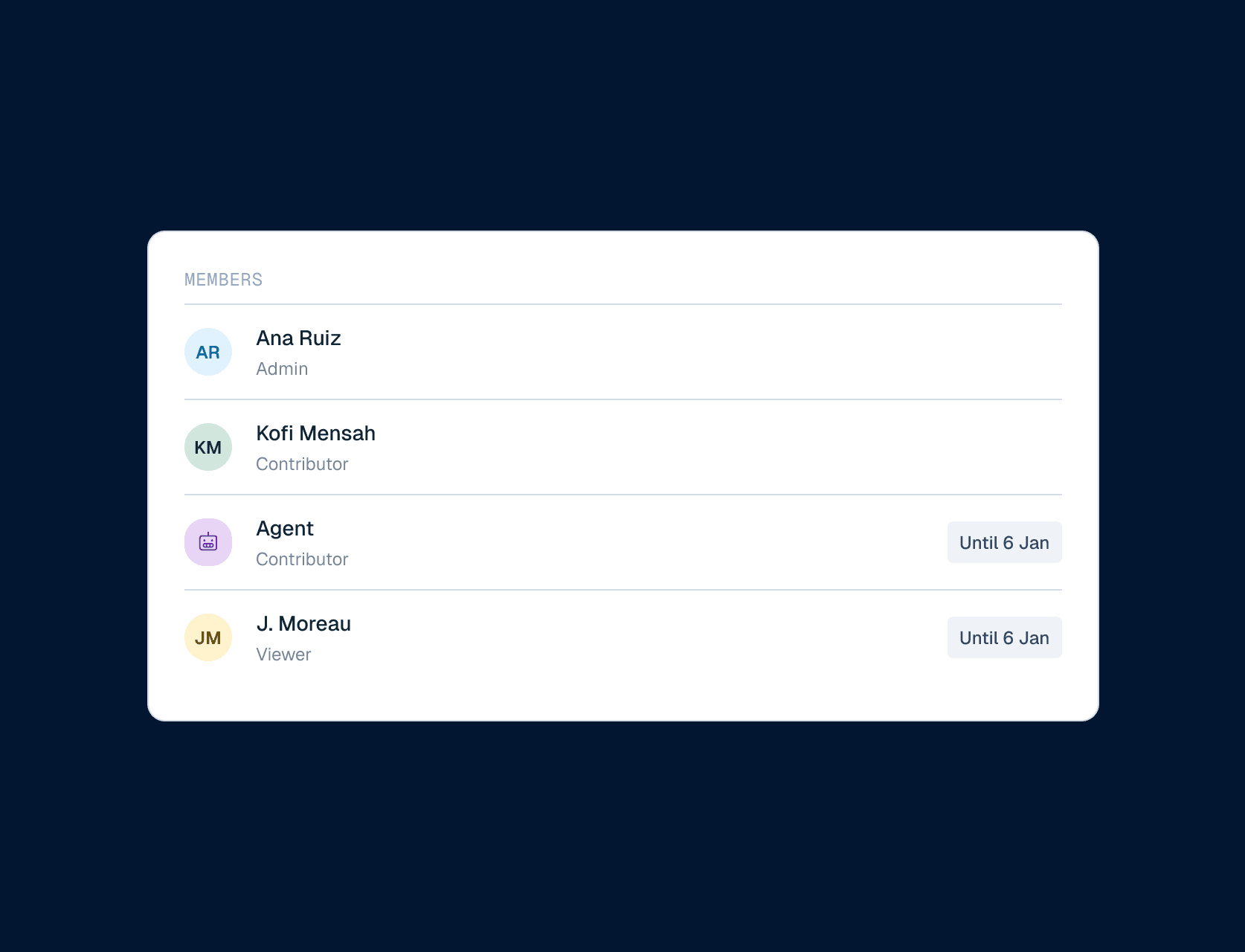
A role, an end date, and credentials that are not a person’s. That is what makes "which agent did this" answerable months later.
A lab's members: Ana Ruiz, Admin; Kofi Mensah, Contributor; an agent, Contributor, until 6 January; J. Moreau, Viewer, until 6 January.

Agent or person, on the same record

The useful question is rarely “what did the model say”. It is “who produced this number, and can I still tell in eighteen months”. Because an agent holds its own membership rather than sharing a person's, the answer is a property of the record instead of something your team has to reconstruct from memory. The agent flag is a label on the member, so it tells you who acted; what an agent is allowed to do is set by the role you gave it.

Inside your own stack, not only ours

The same record is reachable from an API, so the lab is not a place your team has to visit. A service token authenticates a pipeline directly, and the files, versions and membership read back into whatever you already run. Teams with a computational lead usually want the record where their work already lives.

Questions teams ask before they wire an agent up

An AI agent audit trail is a record of which agent did what, and when. On Molecule, each agent holds its own membership in a lab, so every file it adds or changes is attributed to that agent rather than to a person, and every version carries a content hash and a timestamp.

Tell us what your agents actually do

Most teams find the gap is not the model, it is that nobody can say afterwards which run produced which result. Half an hour is usually enough to tell whether this closes it.