
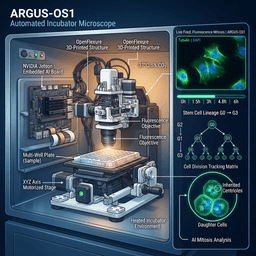

ARGUS-OS1 is the instrument I have been working toward since 2005, when I first argued that the centriole a cell inherits is itself a cellular counter of aging. It is built to watch one question continuously, in live cells, for months: whether the age of the centriole a cell inherits from its grandmother predicts how fast it divides across generations — a lineage-linked aging phenotype that endpoint assays miss. The instrument is an OpenFlexure-derived microscope (CERN OHL) run by a local Jetso
ARGUS-OS1 is the instrument I have been working toward since 2005, when I first argued that the centriole a cell inherits is itself a cellular counter of aging. It is built to watch one question continuously, in live cells, for months: whether the age of the centriole a cell inherits from its grandmother predicts how fast it divides across generations — a lineage-linked aging phenotype that endpoint assays miss.
The instrument is an OpenFlexure-derived microscope (CERN OHL) run by a local Jetso
Owner
Therapeutic Relevance
The proposed mechanism — that inherited centriole age predicts cell-division timing and is relevant to cellular aging — is scientifically plausible and grounded in published literature (multiple PubMed-cited studies on centriole biology, asymmetric inheritance, and stem-cell fate). The hypothesis is falsifiable and well-articulated. However, the link between centriole-age inheritance and a therapeutically actionable aging mechanism remains speculative at this stage. While the project frames division-rate phenotype as a 'screenable endpoint' for senolytics/senomorphics/autophagy activators, no direct therapeutic target or pathway modulation is proposed. The biological question is genuinely novel and unanswered, which is a strength, but the distance from this basic-science observation to a therapeutic intervention is substantial. The mechanism targets a biologically relevant process (cellular aging/renewal failure) but the therapeutic relevance is indirect and contingent on the outcome of the experiment itself.
Therapeutic Optionality
The project demonstrates moderate therapeutic optionality. The proposal explicitly mentions that the platform and readout could generalize to organoids and organs-on-chip, and that a validated centriole-age division-timing phenotype could serve as a screening endpoint across multiple intervention classes (senolytics, senomorphics, autophagy activators). The open-source instrument platform itself has flexibility — it could be repurposed for other long-term live-cell tracking applications beyond centriole biology. However, the core biological question is narrow (centriole age vs. division timing in immortalized fibroblasts), and the therapeutic optionality is largely aspirational at TRL 1-2. No concrete evidence of applicability across multiple therapeutic areas has been demonstrated. The concept's flexibility is real but unproven.
Intellectual Property
The project deliberately adopts an open-source, community-owned IP model (Apache-2.0, CERN-OHL-S, CC-BY) with IP tokenized as an IP-NFT via VitaDAO/Molecule. No traditional patents are filed or planned. While this is philosophically aligned with open science and DeSci, it significantly weakens the project's defensible IP position from a conventional biotech evaluation standpoint. The concept itself — linking centriole age to division timing — is novel and likely patentable in principle, but the team has chosen not to pursue patent protection. The open-source instrument is built on existing platforms (OpenFlexure fork, Cellpose, StarDist), limiting hardware/software IP novelty. Prior art exists in centriole biology (Tkemaladze 2023 and others), though the specific continuous-measurement approach is new. The IP-NFT model provides some community governance value but does not create traditional competitive moats or exclusivity that would attract conventional pharmaceutical/biotech investment.