

Dd
dd
Description
ddTeam
Owner
Project Score
Powered by MIRAUpdated Oct 11, 2026
Technology Readiness Level
Technology Readiness Level
PRE-TRL
TRL 1
TRL 2
Project Progress
All updates
All categories
Timeline
Loading...
dd
Owner
Therapeutic Relevance
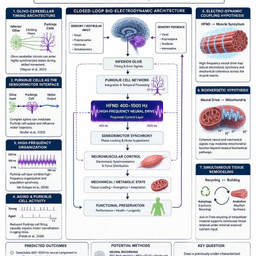
The proposed mechanism — a High-Frequency Neural Drive (HFND) in the 400–1000 Hz range organizing neuromuscular, metabolic, and tissue-remodeling processes via the olivo-cerebellar system — is scientifically imaginative and draws on legitimate published neuroscience (olivo-cerebellar synchronization, Purkinje cell firing, aging-related cerebellar decline). However, the core HFND hypothesis remains entirely unvalidated: no original experimental data exist, the proposed 400–1000 Hz control signal has never been detected, and the downstream mechanisms (electrodynamic muscle coupling, neural-electromagnetic mitochondrial regulation, lipofuscin recycling) are highly speculative. The hypothesis does target biologically relevant processes (motor coordination, aging, neurodegeneration), but the causal chain from HFND to therapeutic intervention is extremely long and unsubstantiated. The supporting 'empirical' evidence is n=1 self-reported biomarker data from the author, which carries negligible scientific weight. While the hypothesis is falsifiable and the author acknowledges its speculative nature, the plausibility gap between established cerebellar neuroscience and the proposed HFND mechanism is substantial. Score of 2 reflects that the concept touches real biology but lacks any direct evidence for its central claim.
Therapeutic Optionality
If the HFND hypothesis were validated, the proposed closed-loop architecture spanning neural control, neuromuscular coordination, metabolic regulation, and tissue remodeling would theoretically have broad therapeutic optionality — potentially applicable to aging/longevity, neurodegenerative diseases, motor disorders, sarcopenia, metabolic dysfunction, and rehabilitation. The model explicitly links cerebellar function to multiple downstream physiological systems. However, this breadth is entirely theoretical; without any validated mechanism, the optionality is speculative. The concept's flexibility is a modest strength — it could pivot across neurology, geriatrics, and biophysics — but the lack of any experimental grounding limits the practical value of this optionality. Score of 3 reflects reasonable conceptual breadth tempered by the absence of any data to anchor therapeutic applications.
Intellectual Property
The HFND concept is novel in its specific formulation — proposing a 400–1000 Hz neural control layer distinct from conventional motor neuron firing — and no direct prior art appears to describe this exact hypothesis. The author has published the concept publicly (DOI assigned, September 2026), which establishes a timestamp but also constitutes a public disclosure that could limit future patent options depending on jurisdiction and timing. No patents have been filed, no IP strategy is described, and the work is by a single independent researcher with no institutional backing or legal IP infrastructure. The underlying neuroscience (olivo-cerebellar synchronization, Purkinje cell firing) is well-established public domain knowledge, so the novel IP space is narrow — limited to the specific HFND hypothesis and any future devices/methods to detect or modulate it. Competition risk is moderate: established cerebellar neuroscience labs could independently arrive at similar hypotheses with far greater experimental capacity. Score of 2 reflects novelty of the specific concept but significant weaknesses in IP protection, strategy, and competitive positioning.