Inside Molecule's Biggest Technical Evolution
Exploring the design decisions, new capabilities, and technical shifts powering Molecule's most transformative release to date.
TL;DR
- The Molecule Protocol is creating verifiable markets for knowledge, compounded by our current build, Labs.
- Labs will leverage smart-wallet standards, creating a new primitive greater than the sum of its parts, allowing the lab to function as both a tradable token and a sovereign container capable of owning any onchain assets.
- We see a future where a scientist can go from idea to market, fully onchain, fully enabled by Molecule.
From Coordination Layer to Programmable Science Economies
Over the past five years, we’ve built technical primitives, legal frameworks, and communities, all of which allowed scientific ideas to live and progress onchain. It opened a floodgate of intellectual property assets into our ecosystem - and while the growth is positive, it presented scalability challenges as many of these assets are dispersed across our ecosystem with limited transparency and economic interrelationships.
Leveraging the rapid evolution of core blockchain standards, we’re excited to share the coming expansion of the Molecule Protocol. Molecule’s core mission of bringing science onchain has never wavered, and we are planning to accelerate that further with the next phase of our technical evolution: the Lab.
Labs Architecture
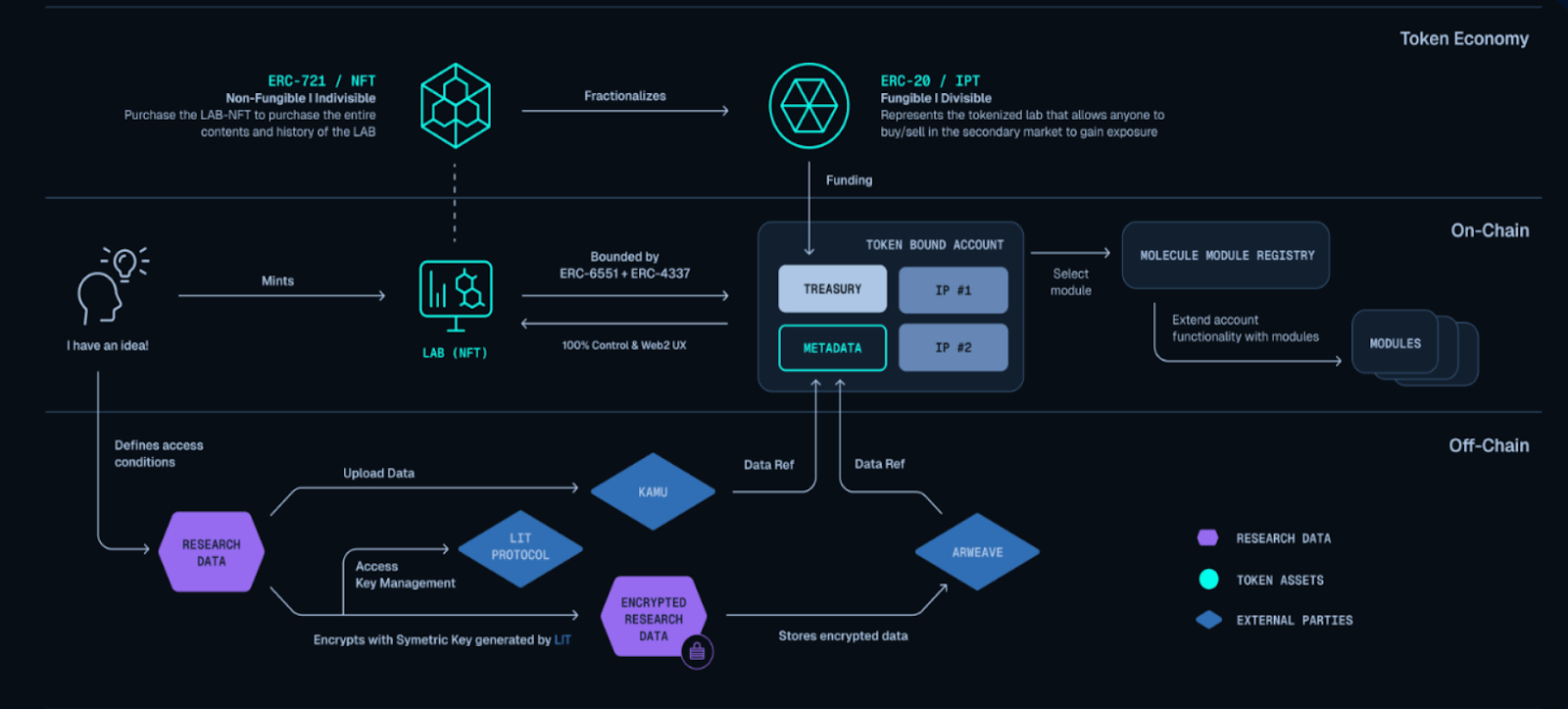
Labs will build on existing smart account standards (ERC-4337 and ERC-6551) to create a new framework for science onchain. This architecture is designed to remove Web3 onboarding friction for scientists and mirror the operations of a traditional lab through a smart-contract wallet architecture (the ‘Lab’) that controls rights to the underlying real-world science
ERC-4337, also known as “Account Abstraction,” gives the onchain Lab a familiar, 'web2' feel by abstracting away the most significant user-experience pain-points, such as gas fees, complex wallet setup, and the need for multiple transaction approvals.
The new architecture pairs the classic NFT (ERC-721) with its own ERC-6551, also known as a “Token Bound Account,” which transforms the humble Non-Fungible Token from a simple digital object into an active onchain agent that can own any onchain digital assets, build a history, and interact with other protocols.
All research data, IP, real-world assets, and onchain treasury funds are consolidated under a single unified account, where its immutable transaction history forms its permanent identity. This transforms the Lab into an open, verifiable entity, allowing the community to audit its progress and contributions, which in turn enables a more accurate price discovery process.
Improved Protocol Functionality
Easy Entry
The Labs architecture dismantles a previously rigid structure whereby the user had to register a Proof-of-Invention (POI), use that to mint an IP-NFT, create the IPTs from the IP-NFT, and only then create a Lab to store data. This is being replaced with a flexible, universal entry point. With Account Abstraction, it is possible for Molecule to sponsor the cost of creating a Lab, making it totally free. It provides a simple answer to the question of where to start: "Just create a Lab."
Persistent Identity, Transient Control
Science is inherently dynamic: it advances through discovery, collaboration, and iteration. Token-bound accounts mirror that motion by transferring control with ownership of the Lab token while preserving a persistent Lab identity. Over time, that identity accumulates a provenance trail of each owner’s contributions, all verifiable onchain. Science never dies; it changes hands.
Modular and Future-Proof
The Lab is a highly composable base layer that can evolve with the ecosystem. New features and tools can be added at any point through our modular architecture. Whether it's BIO launchpads, PumpScience trading mechanisms, Real World Asset frameworks, AI research agents, or technologies we haven't imagined yet, Labs can integrate them permissionlessly. This means the infrastructure we're building today won't become obsolete tomorrow. As DeSci evolves, as new tools emerge, as the convergence of science, AI, and capital markets accelerates, Labs will adapt and incorporate these advances naturally.
Resolving Binary Outcomes
We often see a binary approach with DeSci projects; singular projects either succeed or fail, isolated from the greater ecosystem and mission. If the project fails, valuable data, methodologies, and learnings can go unutilized. This binary outcome model discourages investors and fails to capture the true, continuous value creation inherent in the scientific process. One of the key features of Labs is the ability to contain multiple lines of inquiry, each represented by different onchain assets. When one hypothesis fails, it becomes a valuable data point rather than a catastrophic loss. The project continues, the community remains intact, and funders retain their involvement in the broader mission.
Lab-Level Tokenization
Lab-level tokenization will extend Labs from an asset-custody primitive into an economic coordination primitive. A Lab could mint its own tokens, stake and lock tokens for revenue sharing, accrue assets such as fees and even affiliate to an external token or invite in other assets. In short - the Lab could create its own token economy.
Key Features of the Labs Architecture
- Securely Encrypted Data: The Labs infrastructure is designed with confidentiality as a primary feature, enabling researchers to protect sensitive research and development (R&D) data while still leveraging the benefits of onchain verification. This is achieved through encrypted file uploads and a system of granular, role-based permissions. Only the encrypted file metadata are stored onchain while the underlying raw data remains entirely on the client side.
- Modifiable Role-Based Access: Access to specific files within a Lab can be configured with a variety of onchain conditions, including credential-gated, access-list, payment-gated, licence-gated (in the case of licensing agreements), as well as time-locked.
- IPT Crowdsales: Researchers can fundraise for their research within the Lab interface through the Molecule Foundation, retaining the key functionality of the initial Molecule primitives.
- Milestone-based Funding: Funds can be gradually unlocked as the researcher arrives at each milestone, presenting a more secure and trustless payment system.
- A Verifiable and Transparent Log: A Liquid Lab creates an immutable, timestamped, and publicly auditable record of the entire research lifecycle. This creates what can be described as a "chain of custody" for scientific knowledge. Every step from hypothesis to publication to commercialisation is cryptographically linked and permanently recorded.
The Vision: Idea to Market, Fully Onchain
Imagine a future where:
A graduate student has a breakthrough idea for treating malaria. She creates a Lab - free, instant. She uploads encrypted research data, accessible only to specific collaborators or token holders. She launches Intellectual Property Tokens (IPTs) to fund her work, with contributions flowing into an onchain treasury controlled by milestone-based governance through the Molecule Foundation.
As research progresses, she publishes updates through Labs; datasets, results, conference presentations - all piping directly into the platform where her token holders can track real-time progress. Negative results don't end the project; they become valuable data points stored permanently in the Lab's history.
Meanwhile, the Lab's treasury held at the Foundation actively generates yield through DeFi protocols, creating a self-sustaining financial engine. With modular plug-ins we see AI Agents autonomously accessing datasets and paying automatically, performing computational analysis, and publishing findings in their own Lab - creating a network effect where scientific ingenuity can seamlessly propagate.
The graduate student decides to commercialize her work and bring on investors, using Molecule’s Real-World-Asset legal framework by integrating traditional corporate structures with crypto tokens, enhancing compliance, tax efficiency, and investor appeal while preserving the ethos of decentralization.
When the research matures, exit options multiply: sell the IP real-world asset tokens, launch royalty tokens from licensing deals, tokenize equity for liquidity, pursue traditional acquisition, or IPO. The entire journey - from idea to market - happens onchain.
The future of science begins in the Lab.
What’s Next
We’ve just launched a beta public view of Labs, so our community can get a feel for where things are headed.
We’d love to hear your feedback.
True to the ethos of building in the open, we will be regularly updating our community as Labs comes to life; follow us on X and subscribe to our newsletter.
About the author

Ella McCarthy-Page
BSc(Hons) in Biochemistry and Materials Science. A communicator working at the intersection of biotechnology and web3.